How to do a daily tarot card pull
We make Daily Oracle, a free Android app (with ads) that gives you a daily card, and we mention it near the end. Everything else here works with any paper deck and a notebook.
A daily tarot card pull is the smallest useful tarot practice there is: one card, one question, a few minutes. It's how most people learn the 78 cards without memorising a book, and it's easy to keep up because it asks so little. This guide walks through it step by step, then covers the things that trip people up: what to ask, reversed cards, the same card turning up again, and cards that look alarming.
Why one card works better than a spread
Big spreads like the Celtic Cross are interesting, but they're a lot to hold in your head before breakfast. One card gives you one image to carry through the day. You'll notice it in passing: a conversation that feels like the Two of Cups, a to-do list that looks like the Eight of Pentacles. That noticing is the point. Over a few months you meet every card many times, in the context of your own life rather than a textbook.
It also keeps the practice honest. With one card there's nowhere to hide in a complicated reading. You either find something in it worth thinking about or you don't, and both are fine.
What you need
- A deck. Any 78-card tarot deck works. Many people start with the Rider-Waite-Smith deck or a deck based on it, because every card, including the numbered “pip” cards, has an illustrated scene you can read without knowing the meaning. (Read more in our guide to the Rider-Waite-Smith deck.)
- Somewhere to write. A notebook, the notes app on your phone, or the back of a calendar. One line a day is enough.
- Two to five minutes at roughly the same time each day. Morning suits most people, because you can watch for the card during the day.
How to do a daily pull, step by step
1. Pause for a breath
Before you shuffle, take one slow breath and notice how you're arriving: rushed, tired, curious, anxious. Name it in a word. This takes ten seconds and gives you something to compare with later.
2. Choose an open question (or none)
You don't need a question. If you want one, keep it open and about you: “What should I pay attention to today?” or “What would help me with the meeting at two?” Avoid yes-or-no questions and questions about what other people will do. A card can't tell you whether someone will text you back, but it can prompt you to think about what you want from that conversation.
3. Shuffle and draw
Shuffle however you like: riffle, overhand, or spread the cards face down on a table and swirl them. Stop when it feels done, then take the top card, cut the deck and take the card at the cut, or fan the deck and pick one. No method is more “correct” than another. What matters is that you don't choose the card on purpose.
4. Look before you read
This is the step most people skip, and it's the one that teaches you tarot. Before opening any guidebook, describe what you see in plain words: “A man carrying too many sticks, bent over, walking toward a town.” Notice the colours, the weather, where people are looking, what they're holding. Then ask what part of your life looks like that picture.
5. Read one meaning, not five
Now read a short meaning from one source you trust: the booklet with your deck, a book, or an app. Reading five websites gives you five slightly different answers and turns a reflection into research. Pick a source and stick with it for a few months; you can compare later.
6. Ask one question and write one line
Turn the card into a question for the day. The Seven of Wands might become “What's worth standing my ground on today?” The Four of Cups might become “What am I ignoring because I'm bored with it?” Write the date, the card and one line. Our tarot journaling prompts have questions that work for any card if you get stuck.
7. Check back in the evening
Before bed, read your line again and add a second one: where did the card show up, if anywhere? Some days the answer is “nowhere”, and that's useful too. Over time you'll see which cards you tend to over-read and which ones keep turning out to be apt.
Good questions to ask a daily card
The question shapes what you get out of the card. Questions about your own choices and attention work far better than questions about outcomes.
| Instead of | Try |
|---|---|
| Will I get the job? | What can I do today that makes me a stronger candidate? |
| Does she like me? | What do I want from this friendship, honestly? |
| Will today go badly? | What would help me handle today well? |
| Should I quit? | What part of this situation do I keep avoiding looking at? |
| What will happen? | What am I not noticing? |
Reversed cards: use them or not?
A card is “reversed” when it comes out upside down. Some readers give reversed cards a different meaning, often a blocked, delayed or inward version of the upright one. Others never use reversals and simply turn every card the right way up. Waite's own guide, The Pictorial Key to the Tarot, lists meanings for reversed cards, so the practice is old, but it isn't required.
For a daily pull, our suggestion is to start without reversals. You'll learn 78 meanings instead of 156, and the upright picture already contains plenty of tension to think about. If you want reversals later, decide before you shuffle, and keep the rule the same for a month so your notes are comparable.
“I keep getting the same card”
This is the most common thing new readers notice, and it's mostly arithmetic. If you shuffle well and draw one random card a day from 78, the chance of seeing at least one repeat within a week is about 24%. Within ten days it's about 45%. Within thirty days a repeat is almost certain: over 99%. It's the same effect as two people in a small room sharing a birthday.
So a repeat isn't a message by itself. It can still be a useful prompt: if the Five of Pentacles turns up three times in a fortnight, ask yourself whether there's a worry about money or belonging you haven't looked at. Just don't read the repeat as proof of anything.
A repeat can also mean the shuffle isn't doing its job. If you put each day's card back on top, an overhand shuffle may not move it far. Put the card back in the middle, or shuffle a little longer.
When you draw a “scary” card
Death, the Tower, the Ten of Swords, the Three of Swords: some cards look alarming, and drawing one first thing in the morning can sour the day. Remember what you're doing. A daily pull is a prompt for reflection, and the pictures are symbols. Death is usually read as an ending or a change of chapter, and the Tower as something false or unstable giving way. None of them predicts an event.
A practical approach: ask what in your life is already ending or already shaky, and whether there's something small you could do about it today. If a card leaves you feeling worse rather than more thoughtful, it's fine to put the deck away for a few days. And if you're dealing with something serious, such as health, money, a legal question or your safety, talk to a person qualified to help. A card is never the right tool for that.
Keep a simple log and review it monthly
The real value of a daily pull shows up when you look back. A log can be as simple as this:
| Date | Card | Morning line | Evening line |
|---|---|---|---|
| 3 Nov | Seven of Wands | Hold the line on the deadline. | Did, politely. Felt fine. |
| 4 Nov | Page of Cups | Be open to a small surprise. | Old friend called. Nice. |
| 5 Nov | Four of Swords | Rest without guilt. | Didn't. Worked late. |
Once a month, read the whole page and count a few things: how many Major Arcana cards came up (by chance you'd expect about 28%, since 22 of the 78 cards are Major Arcana), which suit appeared most, and which evening lines surprised you. The pattern in your own notes is usually more interesting than any single card. If you want to learn the trumps properly, our list of Major Arcana meanings gives each one a reflection question.
Doing a daily pull with an app
A paper deck is lovely, but some mornings you won't have it with you. That's what we built Daily Oracle for. It's a free Android app that gives you one card a day from the original 1909 Rider-Waite-Smith deck, with a short reflection and a journaling question for that card, plus a line from Marcus Aurelius or Epictetus, one small action for the day, and the moon phase and moon sign calculated on your phone.
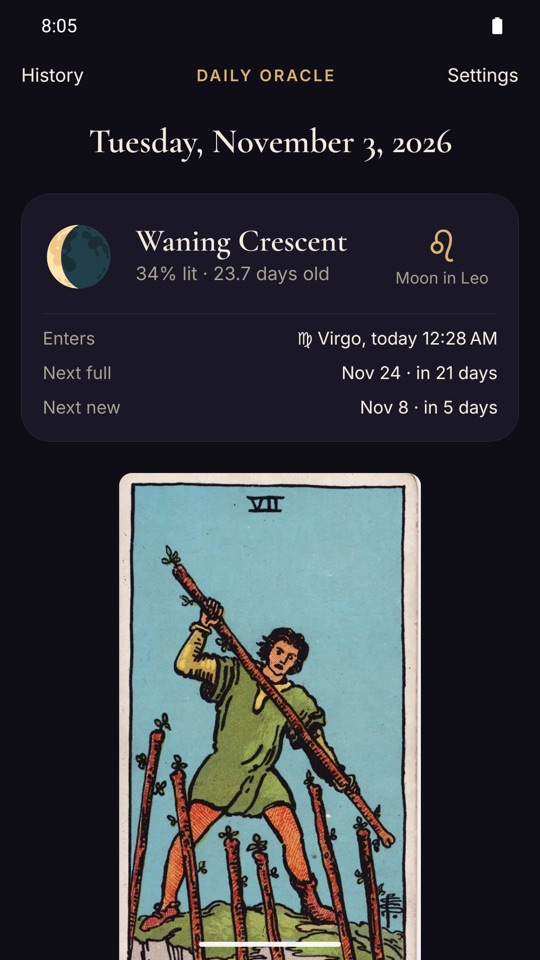
Two design choices are worth knowing. First, everyone who opens the app on the same local date gets the same card, so you can compare notes with a friend. Second, instead of a fresh random draw each day, the cards follow a fixed shuffle for each year, so a card comes back about every 78 days and never sooner than 40. That avoids the “same card three times this week” effect described above. If you want a personal reading, there's a separate 3-card spread for you alone.
The app works offline, has no account, and keeps your history on your phone. It's supported by ads: a banner, an optional video before the 3-card spread, and at most one full-screen ad a day after you share. It doesn't replace the feel of shuffling your own deck; plenty of people use both.
One card, one line, and the real moon.
Daily Oracle for Android: a tarot card from the 1909 Rider-Waite-Smith deck, a Stoic quote, one small action and tonight's moon, calculated offline. Free with ads, no account.
Questions
How long does a daily tarot pull take?
Two to five minutes: a breath, a shuffle, one card, one question and one written line. An evening check-back adds another minute.
Should I ask a question when I pull a daily card?
You don't have to. If you do, keep it open and about your own choices, like “What should I pay attention to today?”, rather than yes-or-no questions about outcomes or other people.
Is it better to pull a card in the morning or at night?
Morning works for most people because you can notice the card during the day and check back in the evening. A night pull suits reflecting on the day that just happened. Pick one and keep it consistent.
Why do I keep drawing the same tarot card?
Mostly chance. With random daily draws from 78 cards, there's about a 24% chance of a repeat within a week and over 99% within a month. Make sure you return the card to the middle of the deck and shuffle well.
Can a daily tarot card predict my day?
No. We treat tarot as a prompt for reflection, not a prediction. The card gives you an image and a question to carry through the day; what you notice and do with it is up to you.
Sources
- Tarot: history and the structure of the 78-card deck (Wikipedia)
- A. E. Waite, The Pictorial Key to the Tarot (1911), full text at Sacred Texts
- Daily Oracle FAQ: how the card of the day and the yearly shuffle work
The repeat-card odds are our own calculation for uniformly random draws with replacement from a 78-card deck (the birthday-problem formula).