Tarot journaling prompts: 60 questions for any card
We make Daily Oracle, a free Android app (with ads) that gives each day's card its own journaling question; we mention it near the end. All the prompts below work with any deck and a notebook.
Tarot and journaling are a natural pair. A tarot card gives you an image you didn't choose, and a journal gives you somewhere to work out what it has to do with your life. Used together, they're less about what the card “means” and more about what you notice when you look at it. Here's a simple way to set up a tarot journal, and 60 prompts to use when you're staring at a blank page.
A tarot journal page in five minutes
You don't need a special notebook or a long ritual. A page with five short parts is enough:
- Date and card. Write the card's name. If you use reversals, note it.
- What I see. Two or three plain sentences describing the picture: people, objects, colours, weather, direction. No meanings yet.
- What I feel. One word for your first reaction. Relief, irritation, curiosity, nothing at all.
- One prompt. Pick one question below and answer it in a sentence or two.
- Evening line. Later in the day, one line: did the card show up anywhere?
The “what I see” step matters most. Describing the picture before reading a meaning trains you to read the card rather than a book, and it's often where the useful insight comes from: you notice the figure in the Eight of Cups is walking away by night, or the Six of Pentacles is about who's holding the scales.
10 prompts for any card
- Where in my life does this scene look familiar right now?
- Which figure in the card am I most like today, and which am I least like?
- What is this card asking me to notice today?
- If this card were advice from a friend who knows me well, what would they be saying?
- What part of the picture did my eye go to first, and why might that be?
- What would I do differently today if I took this card seriously?
- What's happening just outside the edge of the card, before or after this moment?
- What does this card make me want to avoid thinking about?
- What's one small action that fits the spirit of this card?
- If I drew the opposite of this card, what would it look like?
Prompts by suit
Each of the four suits of the Minor Arcana has a broad theme. When you draw a suit card, these prompts tie it to that area of life.
Wands: energy, drive, creativity (5 prompts)
- What am I excited about, and am I giving it any real time?
- Where is my energy going today, and is that where I want it to go?
- What have I started recently that I haven't finished?
- What would I create if nobody were going to see it?
- Where am I pushing when I could pause?
Cups: feelings, relationships, connection (5 prompts)
- What am I feeling that I haven't named yet?
- Who would I like to be closer to, and what's one small step toward them?
- What am I holding on to emotionally that I could set down?
- Where am I giving more than I'm getting, or the other way round?
- What brought me genuine contentment this week?
Swords: thoughts, conflict, truth (5 prompts)
- What story am I telling myself about this situation, and is it true?
- What conversation have I been avoiding?
- Where am I being harder on myself than I would be on a friend?
- What decision would be easier if I wrote down the facts?
- What thought keeps looping, and what would interrupt it?
Pentacles: work, money, body, home (5 prompts)
- What's one practical thing I can do today that my future self will thank me for?
- Where am I spending time or money that doesn't match what I value?
- What skill am I slowly building, and how could I practise it today?
- How is my body doing, and what is it asking for?
- What in my home or routine needs a little maintenance?
Prompts for court cards
Pages, Knights, Queens and Kings are often read as people, or as ways of behaving. These prompts work for any of the 16.
- Who in my life does this person remind me of?
- When do I act like this person, and is it at my best or my worst?
- What would this person do in my situation today?
- What quality does this person have that I'd like more of?
- Is this card a Page (learning), Knight (pursuing), Queen (mastering inwardly) or King (mastering outwardly)? Which of those stages am I at with my current project?
Prompts for the Major Arcana
When one of the 22 trump cards comes up, the theme is usually bigger than one day. These prompts help you zoom out. For a question tailored to each card, see our list of Major Arcana meanings.
- What larger chapter of my life does this card belong to?
- If this card described the next three months, what would I want to be true at the end of them?
- What lesson have I met before that this card is reminding me of?
- What would it look like to take this card's theme one step further today?
- Where does this card sit between the Fool (beginning) and the World (completion), and where do I feel I am?
Prompts for hard cards
Some cards are uncomfortable to draw: the Tower, Death, the Ten of Swords, the Three of Swords, the Five of Pentacles. Remember they're symbols, not forecasts. These prompts turn discomfort into something useful.
- What is this card showing me that I already suspected?
- What's the smallest, kindest thing I could do about it today?
- What in this picture is temporary?
- Who could I ask for help, and what would I ask?
- If a friend drew this card, what would I tell them?
If a card leaves you feeling worse rather than more thoughtful, it's fine to close the journal for the day. And for anything serious in your health, finances, safety or legal situation, talk to someone qualified, not a deck of cards.
Prompts for reversed cards
If you read reversals, an upside-down card is often taken as its theme turned inward, held back or overdone. Three questions cover most cases:
- Where is this card's energy blocked or delayed in my life?
- Am I overdoing this card's quality, or not using it at all?
- What would this card look like if I turned it the right way up today?
Prompts for the new moon and full moon
Many people like to mark the moon's cycle in their journal. The new moon and full moon are about 15 days apart, which makes them handy check-in points. (Our guide to moon phases and moon signs explains the astronomy.) Treat these as a calendar for reflection, not as an influence.
New moon
- What do I want to begin in the next four weeks?
- What's one habit I'd like to try until the next new moon?
- What would I like to have noticed by the full moon?
Full moon
- What has grown or become clearer since the new moon?
- What am I ready to let go of before the next cycle?
- What surprised me in my cards over the past two weeks?
Prompts for a monthly review
A journal becomes much more valuable when you read it back. Once a month, flip through your pages and answer these:
- Which suit came up most, and does that match how the month felt?
- Which card came up more than once, and what was happening each time?
- Which evening line surprised me most?
- Which prompt produced my most honest answer?
- What will I pay more attention to next month?
- What did I learn about myself that had nothing to do with the cards?
Tips that keep a tarot journal going
- Keep it short. A two-line entry you write every day beats a page you write once a week. Our guide to a one-minute morning ritual shows how small a daily practice can be.
- Write the card first, even on busy days. The date and card name alone become a useful record.
- Don't look up meanings every time. Once you've read a card's meaning twice, try answering from the picture alone.
- Be honest, not impressive. Nobody else needs to read it. “Didn't think about it once” is a valid evening line.
- Mix in other prompts. A line from a Stoic writer works well alongside a card. See our Stoic quotes for daily reflection.
Journaling with Daily Oracle
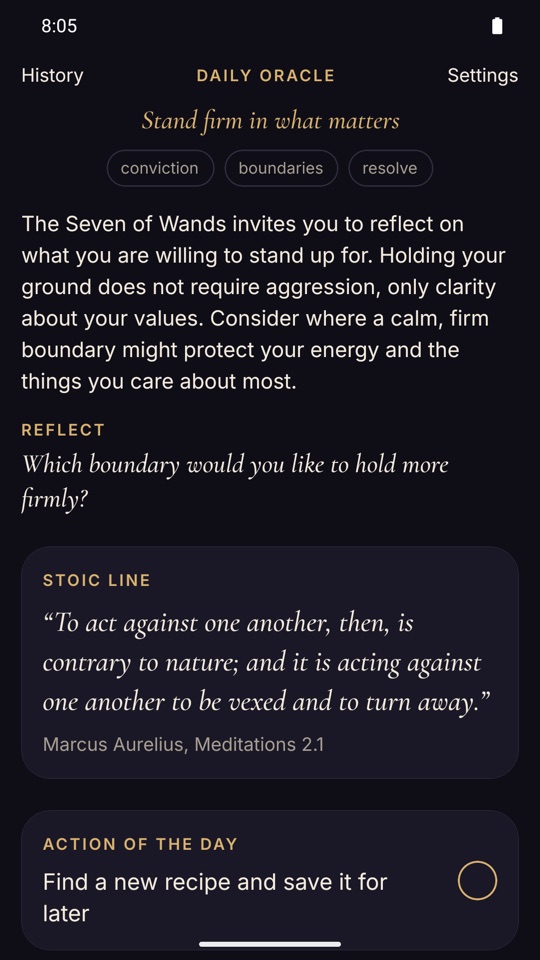
If you'd rather not shuffle a deck every morning, Daily Oracle does the drawing and gives you a starting point. Each day's card, from the original 1909 Rider-Waite-Smith deck, comes with a short reflection and a question to journal on, written for that card. There's also a line from Marcus Aurelius or Epictetus and one small action for the day. The app keeps a history of every card you've drawn, with the moon that night and whether you did the action, so it doubles as a log for your monthly review. You write your answers wherever you like: a notebook, your notes app, or the back of an envelope. It's free with ads, works offline and needs no account.
One card, one line, and the real moon.
Daily Oracle for Android: a tarot card from the 1909 Rider-Waite-Smith deck, a Stoic quote, one small action and tonight's moon, calculated offline. Free with ads, no account.
Questions
How do I start a tarot journal?
Use any notebook. For each entry write the date and card, two or three sentences describing the picture, one word for how you feel, an answer to one prompt, and an evening line about whether the card showed up. Five minutes is enough.
What should I write in a tarot journal?
Describe the card's image before you read its meaning, then answer one question such as “Where in my life does this scene look familiar?” or “What is this card asking me to notice today?”. Short, honest entries are more useful than long ones.
Do I need to know card meanings to journal with tarot?
No. Describing the picture and answering an open question works even if you've never read a guidebook. Meanings come with time, and looking closely at the images is one of the best ways to learn them.
How often should I write in a tarot journal?
Daily works best if entries are short, two or three lines. Read the journal back once a month to spot patterns in suits, repeated cards and your own answers.
Can I use these prompts with oracle cards?
Most of them, yes. The prompts for any card, hard cards, moon phases and monthly reviews work with any deck. The suit and court card prompts are specific to tarot.
Sources
- A. E. Waite, The Pictorial Key to the Tarot (1911), full text at Sacred Texts
- Tarot: the four suits and court cards (Wikipedia)
- NASA: Moon phases
All prompts were written for this guide.